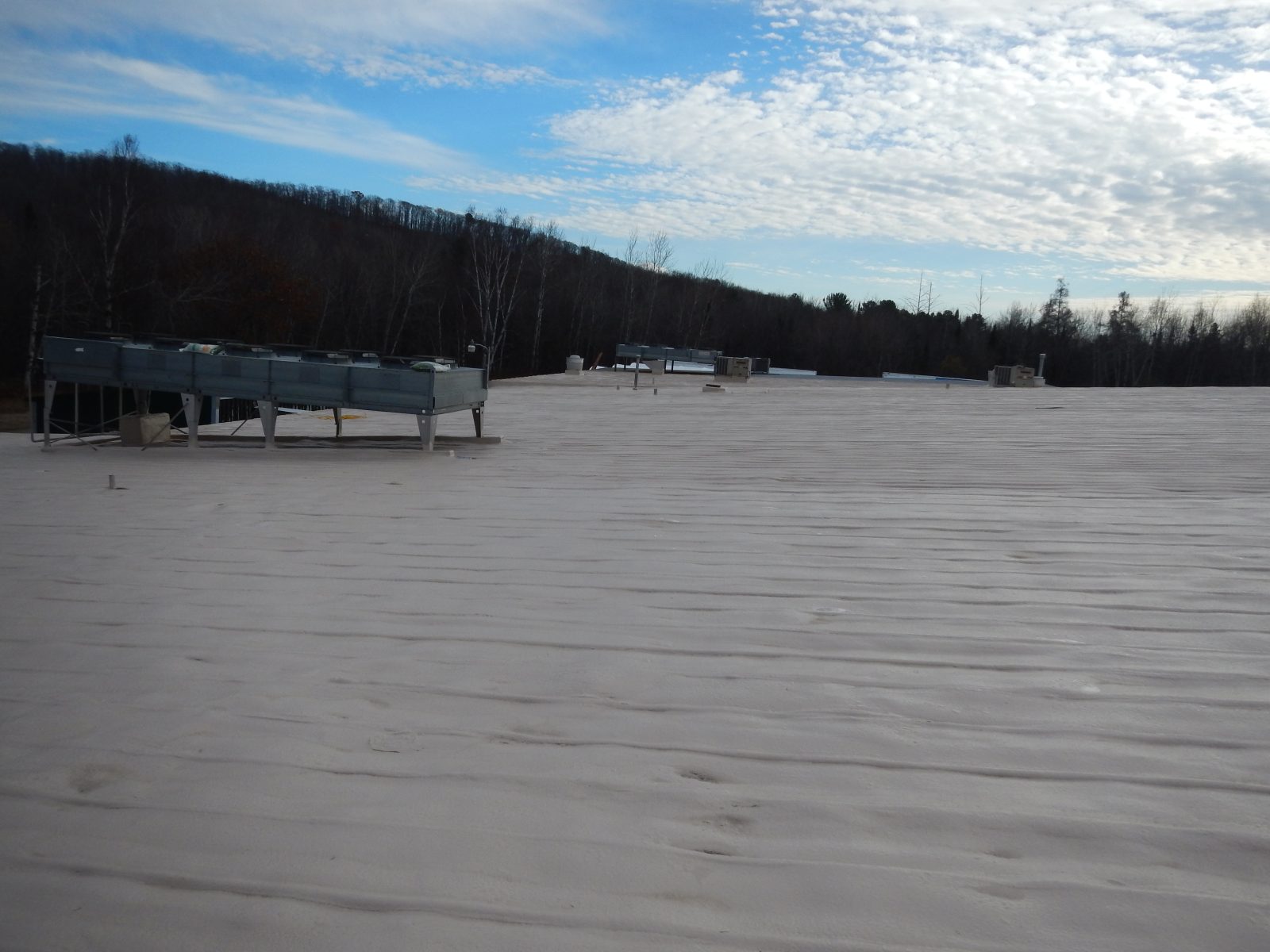
The Coating System
Prep by condition, primer by panel finish, thickness by exposure. The engineering behind a steel roof restoration.
Request the Full Spec SheetWhy Pure Polyurea on Steel
OR-80SLM is a pure polyurea — amine-terminated resin and isocyanate, no polyol extender, no catalyst. Two consequences matter on a steel roof.
It is not moisture-sensitive during cure. Steel roofs collect dew. A crew starting at seven in the morning on a panel that was below the dew point at five is a routine situation, and a moisture-sensitive coating will foam, blush, or blister. Pure polyurea will not. It still needs a substrate that is above dew point and free of standing water, but the cure chemistry itself is not fighting you.
It gels in 3 to 6 seconds. On a large agricultural or industrial roof with weather moving through, the ability to spray a section and have it tack-free within 30 seconds means there is no partially cured area waiting to be ruined by an afternoon storm. Whatever was sprayed is weathertight.
Add 100% solids — no shrinkage, no solvent entrapment, every wet mil kept as a dry mil — and pull-off adhesion above 500 PSI on properly prepared steel, and you have a membrane that is genuinely bonded to the roof rather than mechanically resting on it.
OR-80SLM on Steel — Specification
| Property | Value |
|---|---|
| Chemistry | Pure polyurea, 100% solids |
| Approval | Miami-Dade approved |
| Adhesion, blasted steel | > 500 PSI pull-off |
| Tensile strength | 2,500 – 3,000 PSI |
| Elongation | 300 – 400% |
| Tear strength | 400 – 500 pli |
| Gel time | 3 – 6 seconds |
| Tack-free time | 10 – 30 seconds |
| Recoat window | Up to 6 hours without re-prep |
| Service temperature | −40°F to 250°F |
| Field DFT, steel panel | 40 – 60 mil |
| Lap & fastener stripe pass | Additional 20 – 30 mil |
| Traffic / hail zones | FJ1 at 80 – 100 mil |
| Coverage | 1,604 mil-sq-ft per gallon |
| Corrugated panel allowance | Add 15 – 25% for developed surface area |
| Equipment | Plural-component proportioner, heated hose |
Prep: Three Cases, Three Specs
Case 1 — New or heavily corroded bare steel. SSPC-SP6 commercial blast to a 2–4 mil angular profile. This is the specification that earns the full adhesion numbers and the full warranty. On heavily corroded panel, blasting also tells you the truth about remaining section thickness, which is information worth having before you coat.
Case 2 — Maintenance overcoat of tight rust. Where the rust is sound and tightly adhered and blasting an occupied building is impractical, SSPC-SP3 power-tool cleaning is acceptable with a reduced-warranty note. The membrane bridges the tight oxide and cuts it off from oxygen and moisture, which stops the reaction. What it cannot do is reverse section loss that already happened. The test is simple: if a scraper takes it off, it goes; if it does not, it can stay.
Case 3 — Galvanized, Galvalume, or previously coated panel. This is where 7001 Primer becomes mandatory rather than advisable. Zinc and zinc-aluminum surfaces do not accept a direct polyurea bond reliably, and aged panel carries chalk and zinc salts that must come off first. Pressure wash to remove chalking and white rust, allow to dry, then prime. On panels with old aluminized asphalt or acrylic coatings, 7001 also blocks bleed-through.
Every case — coastal and wash-down buildings: verify soluble chlorides below 7 µg/cm². Salt left under a membrane will osmotically blister it. Food processing plants, dairy wash-down bays, and coastal ag buildings are where we see this most.
Where the Foam Goes
On top of low-slope steel deck. Closed-cell foam adds continuous R-value across the whole plane with no thermal bridging at the fasteners or purlins, and because it is sprayed it can be tapered in the field to build slope toward the drains on a roof that ponds. OR-80SLM then goes over it at 60 mil minimum as the UV and impact surface — foam cannot be left bare.
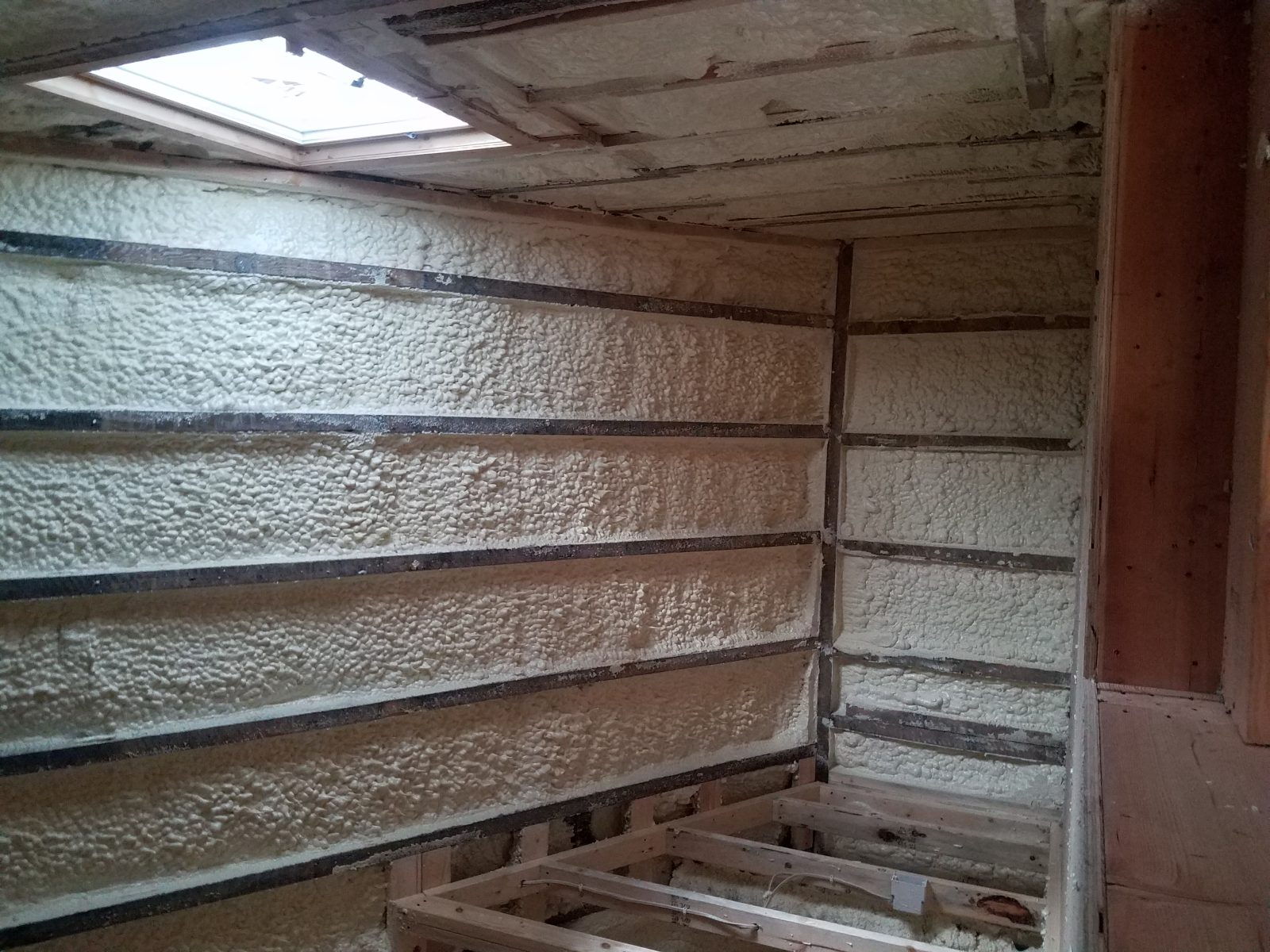
Under the deck, between bar joists and purlins. This is the condensation fix. Foam in direct contact with the underside of the steel seals continuously around every joist and purlin, acts as its own vapor retarder, and moves the dew point out of the metal. Livestock barns, poultry houses, produce storage, and any heated building under a cold deck.
Both approaches use the same equipment class as the membrane, so a single crew and a single rig handles the whole assembly.
Need the TDS, SDS & Miami-Dade Documentation?
We will send the complete data package for OR-80SLM, FJ1, OR7K, and 7001 Primer, plus foam data if the assembly includes it.
Request DocumentationGet a Steel Roof Spec & Quote
Tell us about your project and we will follow up with product details, technical data sheets, and pricing.